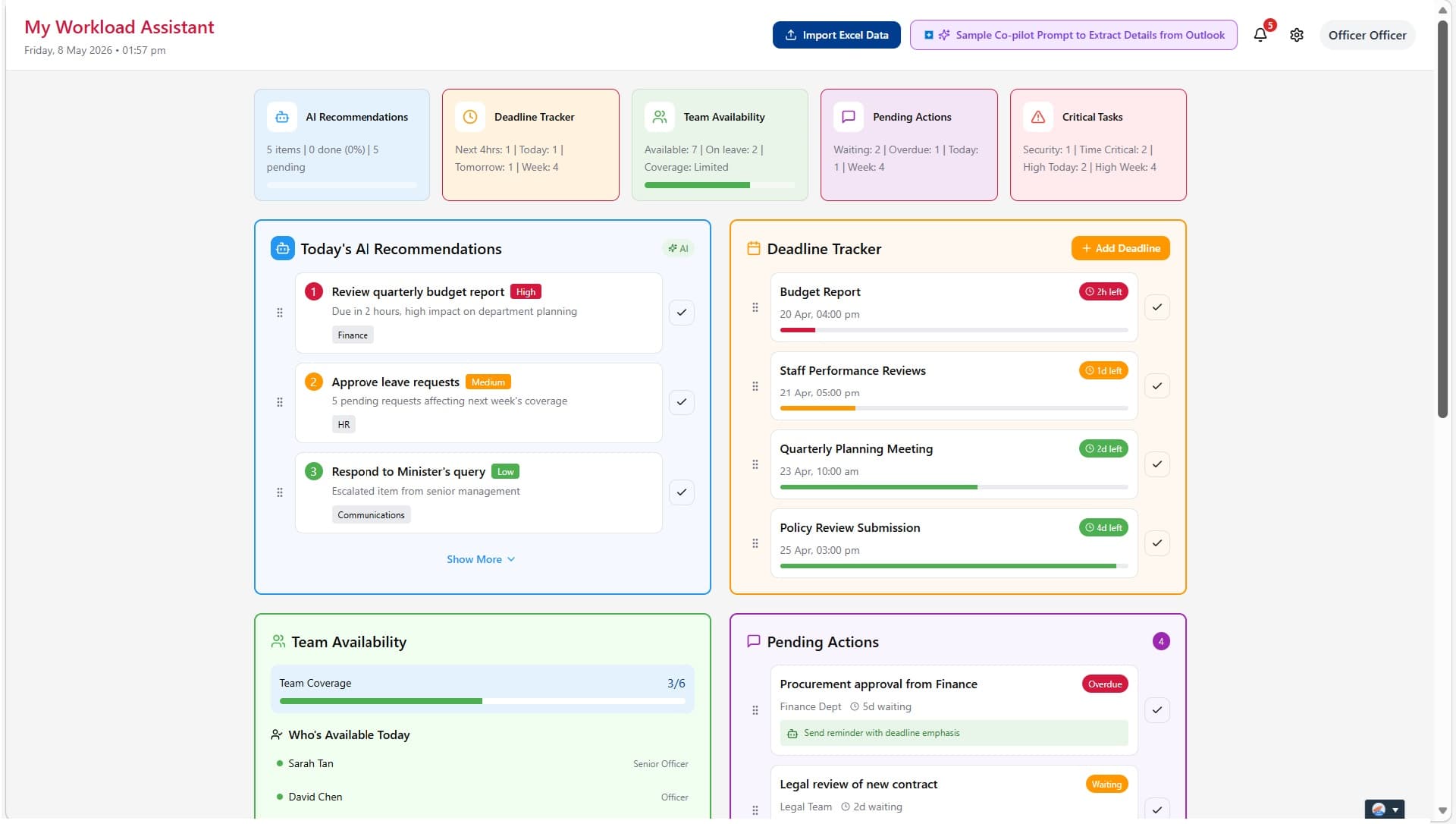
Public officers currently struggle to manage multiple concurrent responsibilities, deadlines and administrative tasks without centralized AI dashboard
Public officers across multiple government agencies, with cascading effects on millions of citizens who depend on timely and efficient government services.
Public officers need to effectively manage and prioritise their daily workload, which includes tracking project deadlines, monitoring high-priority items, keeping track of leave schedules to ensure support is available, following up on pending actions, and ensuring critical tasks receive appropriate attention.
Lack of Integrated Systems Architecture:
The fundamental issue stems from the absence of interconnected government systems that can communicate and share data seamlessly. Different departments and functions operate on separate platforms without standardised data exchange protocols.
Insufficient Digital Transformation:
Many government processes still rely on legacy systems and manual workflows that were not designed for modern collaborative work environments. The digital infrastructure has not evolved to support integrated task and resource management.
Absence of Centralised Data Management:
There is no unified data repository that consolidates task information, personnel schedules, project timelines, and follow-up actions. Data silos prevent comprehensive visibility across different work streams.
Limited Investment in AI and Analytics:
Current systems lack intelligent algorithms that can analyse workload patterns, predict potential conflicts, and provide proactive recommendations for task prioritisation and resource allocation.
Individual Officer Impact:
Poor workload management leads to increased stress and burnout from the constant fear of missing deadlines, reduced job satisfaction and productivity due to time wasted on administrative coordination, hindered career progression from missed opportunities and deadline failures, and deteriorating work-life balance from inefficient time management.
Team and Departmental Impact:
At the team level, the consequences include project delays and missed deliverables affecting service delivery to citizens, poor coordination leading to duplicated efforts and resource wastage, increased operational costs from inefficient resource allocation and overtime requirements, and reduced team morale and collaboration due to scheduling conflicts and communication gaps.
Organisational Impact:
At the organisational level, delayed services diminish public trust, manual processes inflate operational expenses, and government effectiveness in policy implementation and service delivery is reduced. This also places the public sector at a competitive disadvantage compared to private sector efficiency standards.
Citizen Impact:
Citizens bear the ultimate cost through delayed access to essential government services and support programmes, reduced quality of public service delivery due to officer overwhelm and poor prioritisation, and decreased confidence in government capability and responsiveness.
Scale of Impact:
These challenges affect thousands of public officers across multiple agencies, with cascading effects on millions of citizens who depend on timely and efficient government services. The cumulative cost includes both direct operational expenses and indirect impacts on Singapore's reputation for administrative excellence.
Validation was conducted through face-to-face sessions with users, including the team members themselves, who are public officers and thus direct users of the product. Additional feedback was gathered from other public officers. Key insights from these sessions included the need to integrate with Microsoft Outlook, which is the common communication platform across the public service, so that workload details can be loaded directly from it. Users also highlighted the need for clear steps to extract relevant details from Outlook via Copilot. Additionally, officers expressed a strong preference for a solution that is quick and responsive, with minimal waiting time, which informed the decision to include an Excel upload facility for faster data loading.
A key risk identified is the sensitivity of individual workload data — officers' dashboard information must remain private and not be accessible to other team members or colleagues. To mitigate this, the product implements OTP-based login, ensuring that only the officer whose dashboard it is can access their own data.
The solution has broad applicability across the Whole-of-Government (WOG), as the workload management challenges it addresses are common to public officers at the individual level across all agencies.
AIMyWorkload Dashboard provides a centralised AI-powered platform that consolidates task management, deadline tracking, leave schedules, and priority monitoring into a single interface, eliminating the fragmentation caused by disparate systems and enabling public officers to manage their workload more efficiently.
The officer logs in securely using an OTP sent to their official government email address, ensuring that access to the dashboard is strictly personal and limited to the individual officer. Once logged in, the officer can load their tasks and workload details directly from Microsoft Outlook, review their consolidated task list, and mark tasks as complete with a single click. The AI component then analyses the remaining workload and surfaces the next most important task for the officer to focus on.
The dashboard is designed for speed and simplicity. Officers can quickly pull in their tasks from Outlook — their primary communication tool — without manual re-entry of information. Completing a task requires just a single click, and the AI assistant proactively recommends the next priority task, reducing the cognitive load of having to decide what to work on next. This keeps the experience lightweight and efficient, respecting officers' time.
Users expressed a desire for the dashboard to connect with all their work systems, though they acknowledged this was not immediately feasible. Despite this limitation, feedback was positive — officers were satisfied that the product could effectively surface and organise tasks from Outlook, which serves as the primary communication and coordination channel for most of their work, including team leave status and meeting invites. The Outlook integration was seen as a practical and meaningful starting point that addressed their most pressing workload visibility needs.
The North Star for AIMyWorkload Dashboard is to become a fully integrated workload management platform that connects seamlessly with all the systems a government officer works across, providing a single, comprehensive view of their responsibilities and priorities.
In the short term, the Proof of Concept (POC) aims to demonstrate that the dashboard can effectively support individual workload tracking by using task and schedule data drawn from the officer's Outlook email. A successful POC will validate the core concept and lay the groundwork for broader system integrations in subsequent phases, with the longer-term vision of expanding connectivity across all government platforms to deliver a truly unified workload management experience for public officers WOG.