A Singapore Government Agency Website
How to identify

How Might We digitalise the complicated consent taking process for the citizens and their family members at the medical institutions to make claims when they are seeking medical treatment?
Business sponsor: Wong Wenjie, Ang Wei Hong, MOH Healthcare Finance
How Might We digitalise the complicated consent taking process for the citizens and their family members at the medical institutions to make claims when they are seeking medical treatments?
Background
When a patient seeks treatments from one or more medical institutions, they may or may not authorise the medical institution(s) to deduct from their Medisave accounts and/or their family members' Medisave accounts. In addition, they may or may not authorise the medical institution(s) to use their MediShield Life accounts and Integrated Plan to pay for the medical bills.
Team carried out a user interview with our problem owner (MOH Healthcare Finance Officer), the medical institutions staff and the patients to understand the user’s pain points and challenges.
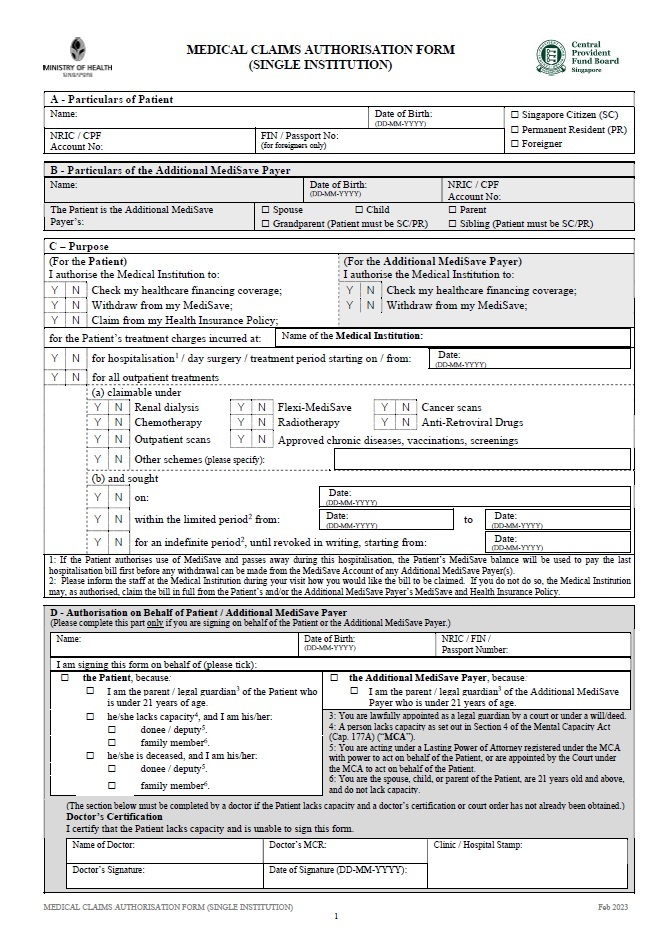
Current Process: Currently patients and their family members as payors have to fill up a physical paper form which is complicated that the hospital has to scan, safekeep, and manually update into the hospital billing system with eye-balling required to minimize mistake which could still have lapses over time (error-prone).
Current Consent Form:
The team carried out user interview with our problem owner, the medical institutions' staff and some patients to understand the user’s pain point and challenges. Our problem statement has been refined over few iterations with better understanding of user's pain points.
Current Process: Currently patients and their family members as payors have to fill up a physical paper form which is complicated that the hospital has to scan, safekeep, and manually update into the hospital billing system with eye-balling required to minimize mistake which could still have lapses over time (error-prone).
Key Insights Gathered from Interviews
1. Patients and family members struggle with the complicated form
2. Patients and family members don't know what they have consented before
3. Modifying or revoking consent is a cumbersome process
Through service journey mapping and design thinking ideation process, we:
Transform consent form from this complicated physical form:
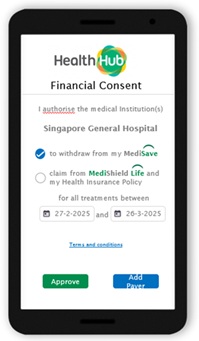
to this simple digital form:
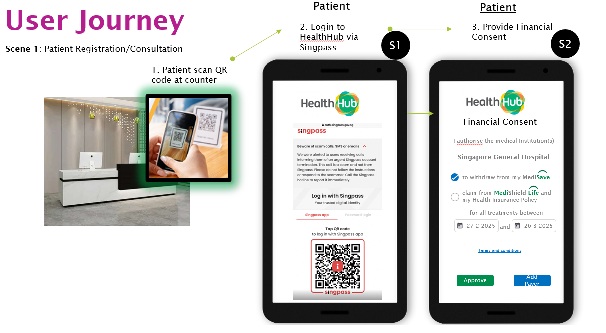
Proposed user journey for patients to provide consent (to illustrate eConsent simplification and leverage Singpass):
As part of the Minimum Viable Product (MVP), users can scan a QR code at the hospital front desk during their initial visit. This will direct them to log in via Singpass and land on the HealthHub consent page, where the following details are pre-filled:
- Hospital name,
- NRIC, and
- Default consent period
From here, the user simply needs to:
- Choose whether to consent to deductions from:
- MediSave, and/or
- MediShield Life & Integrated insurance plans.
- Optionally, add additional family members as payors if needed.
(Note: more user journey available upon request)
We have conducted Usability Testing (UT) with users and gathered valuable early feedback. Based on these insights, our current plan is to proceed with Proof of Concept (POC) and Proof of Value (POV) phases in collaboration with selected medical institutions, such as KKH and SKH.
Once sufficient feedback is collected and initial issues are resolved, we will roll out Release 1 as a Minimum Viable Product (MVP) to all medical institutions.
In Release 2, we will focus on addressing the needs of medical institutions, including:
Following this, Release 3 will expand the eConsent services to cover additional consent services within the healthcare sector.
Finally, in Release 4, we will explore further expansion to other government agencies, extending the eConsent services to cover other government-related services.