A Singapore Government Agency Website
How to identify
Scam education, redefined!
Scam education --- redefined! Check out our experiential learning platform !
How can scam education training be more effective to improve a scam victim’s alertness against future scams?
Despite the proliferation of scam education information via integrated marketing campaigns (eg. SPF's 'I can ACT' campaign) and social media campaigns by various social media and e-commerce agencies, the number of scams and cybercrime cases has increased by 10.8% in 2024 compared to 2023 according to SPF's Annual Scams and Cybercrime Brief 2024.
Through our research and interviews, we found various gaps in existing scam education:
As such, we plan to approach scam education from an angle less explored --- Just-in-time (JIT) education. This approach not only tackles the generality of existing scam education efforts, but also provides modularity and allows for quick adaptation to target new scam Modus Operandi (MO).
This strategy encompasses both the and to more actively help scam victims develop "spidey senses" against future scams.
Our final solution aims to directly target two critical aspects of alertness and sensitivity to potential scams:
The application will be equipped with user flows featuring the latest and most prominent scam tactics. Combined with shock factors, this will let user undergo of what could be an actual scam attempt.
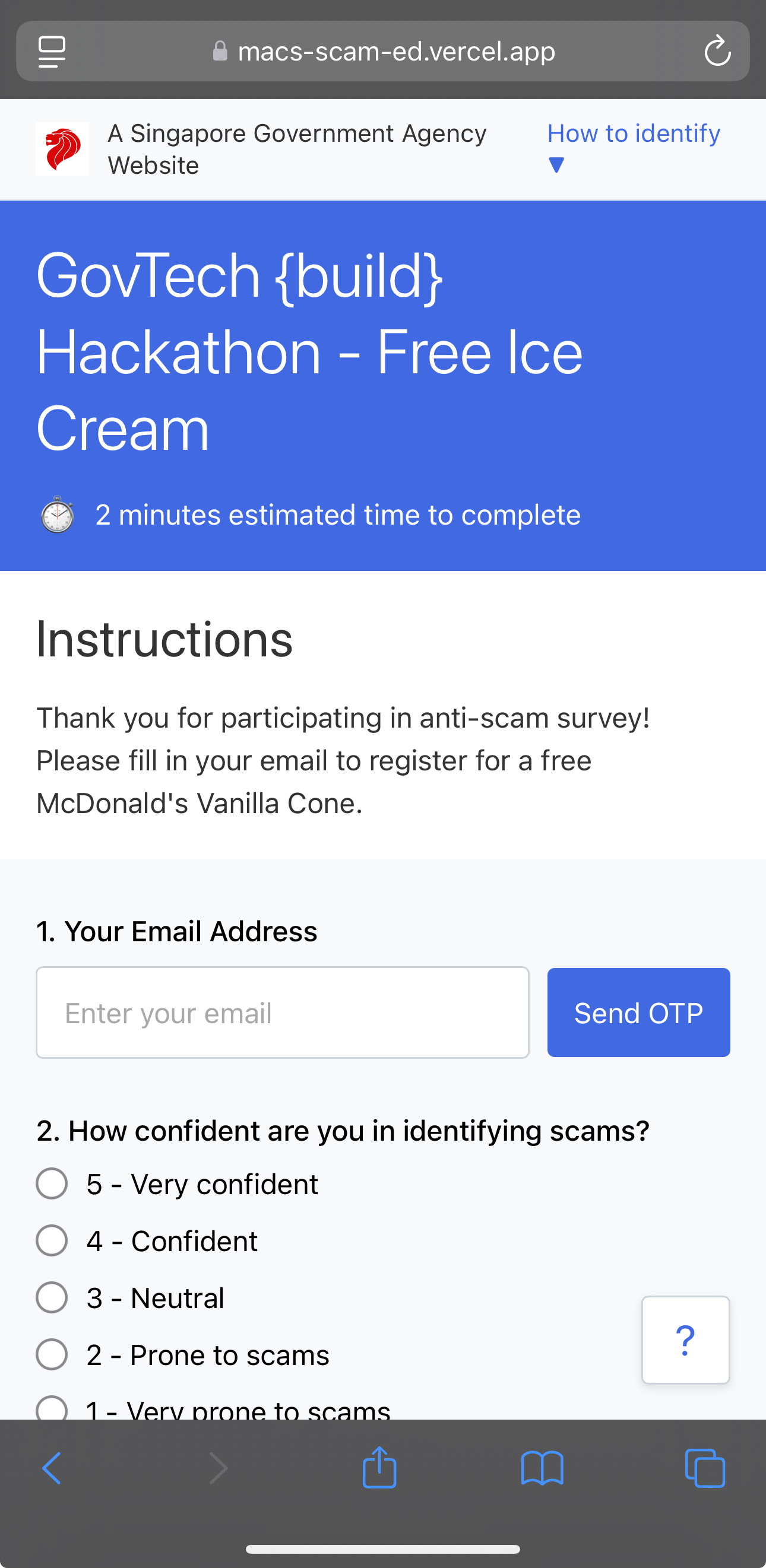
For this hackathon, we built a POC of one such experience, targeting OTP and government impersonation scams.
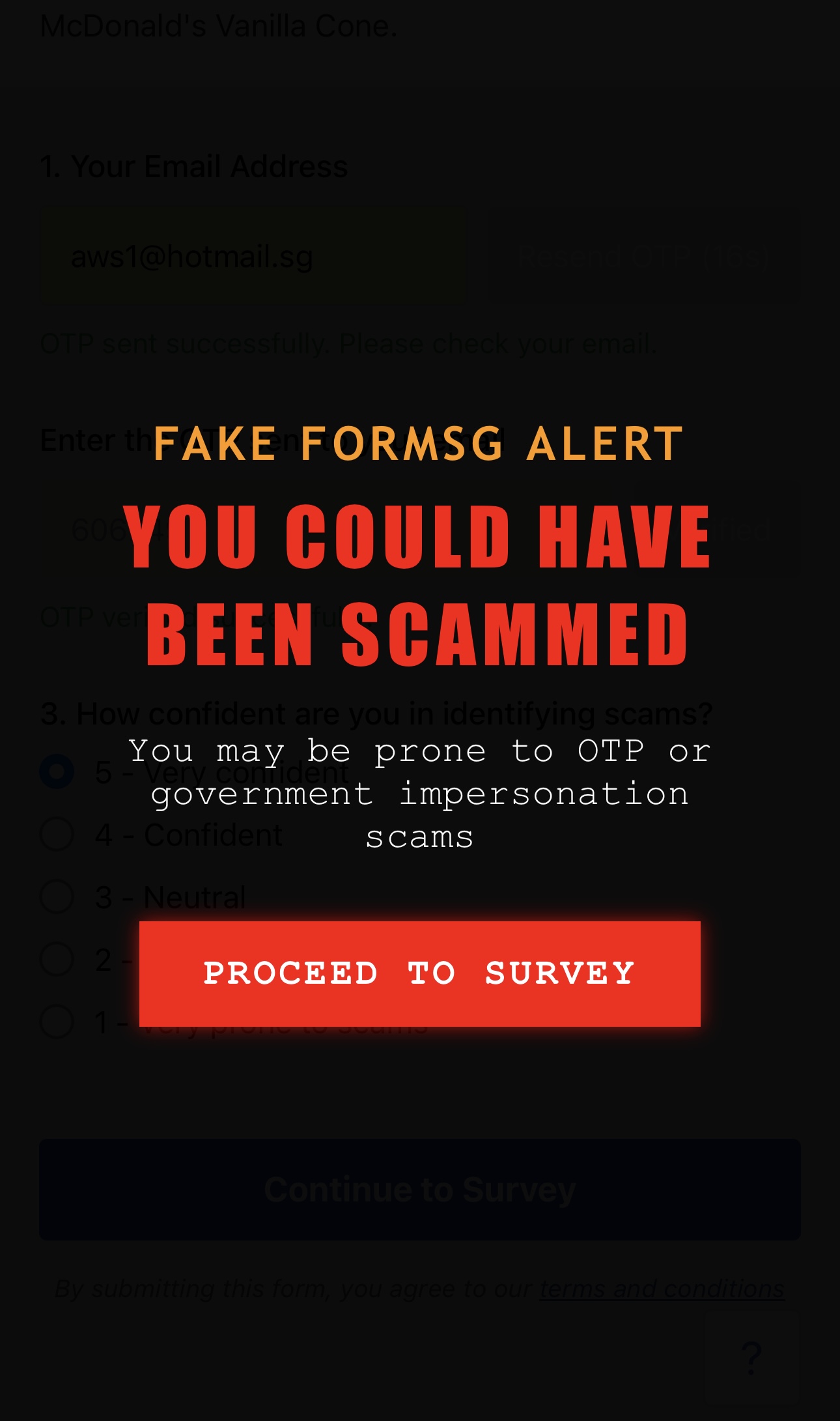
Fake FormSG Website
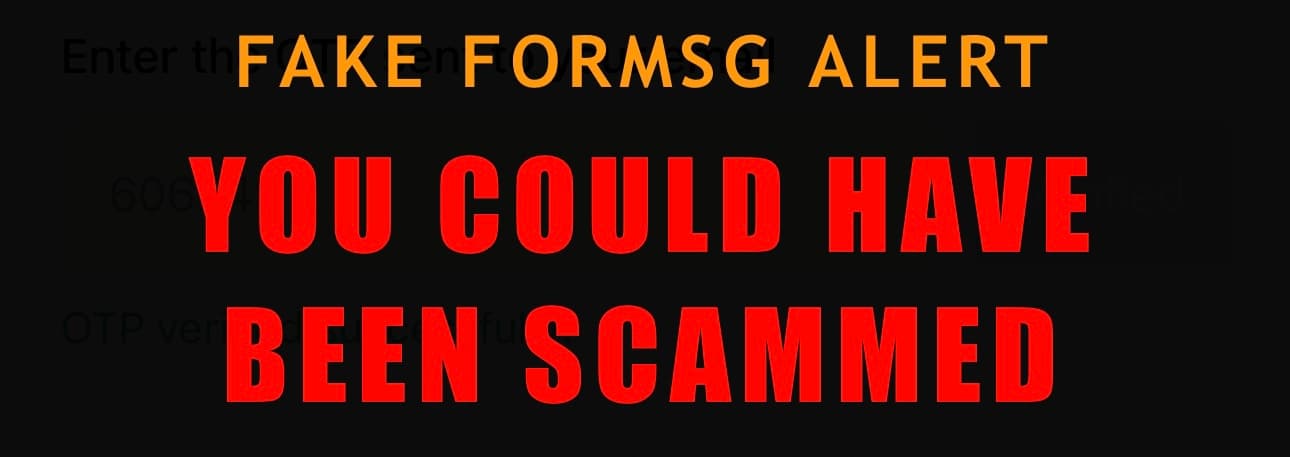
Alert - Shock Factor
User Research
From our user research conducted alongside our scam simulation exercise, this are the key findings:
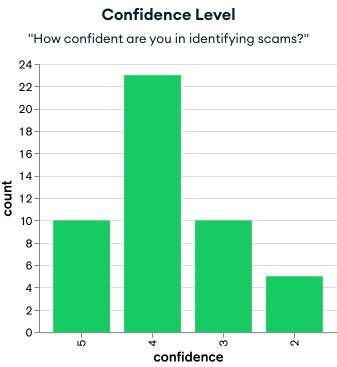
Generated with MongoDB Charts
Upon feedback, we ultimately deduced that our product is relevant and effective in promoting scam awareness among users, given that the simulations are up-to-date to current scam trends.
📱 App Effectiveness: 4.09/5 ⭐ (34)
📊 App Rating: 4.47/5 ⭐ (34)
Modular Application The code handling UI and functionality of the mock scam will be modularised such that it can be easily plugged-and-played. The education aspect is currently handled with a low-code solution in the form of a reflection survey, but ideally should be implemented within each module. This architecture allows the development team to quickly spin up new simulations when scam trends change.
Improved Education UI/UX Besides upgrading from a no-code solution, further plans for the education portion include interactive modules. One method can even be gamification --- think "spot the difference" game.
Long-term Business Plan A possible model for the product is a subscription model. By subscribing to this service, users will be periodically sent mock-phishing messages or simulation invites. This keeps them update to date about the latest scam trends as well as actively reminds them to be vigilant about scams.