A Singapore Government Agency Website
How to identify
Official website links end with .gov.sg
Government agencies communicate via .gov.sg websites (e.g. go.gov.sg/open). Trusted websites
Secure websites use HTTPS
Look for a lock () or https:// as an added precaution. Share sensitive information only on official, secure websites.
LogoLogoHomeAboutFAQsEventsProblem Statements
LogoLogo
Sign up here

{build} Hackathon & Incubator

Are you ready to be part of the next {build}?

Contact UsReport VulnerabilityPrivacy StatementTerms of Use
GovTech 10th AnniversaryGovTech 10th Anniversary

© 2026 Government Technology Agency of Singapore | GovTech

Projects/Developer Tooling
Opus
Opus logo

Opus

Introducing Opus, a workflow orchestrator consolidating frequently used process components on a single platform. Boasting out-of-the-box integration with WOG tools such as OGRE (for Rule Engine needs), APEX (API needs), and CFT (file transfer), Opus makes complex business flows easy, efficient, and compliant.

Shortlisted for IncubatorBooth DT8 & DT9

Back to all projects

Opus

Introducing Opus, a workflow orchestrator consolidating frequently used process components on a single platform. Boasting out-of-the-box integration with WOG tools such as OGRE (for Rule Engine needs), APEX (API needs), and CFT (file transfer), Opus makes complex business flows easy, efficient, and compliant.

Problem Statement

In the public sector, agencies lacking technical expertise often contract vendors to embed workflow processes directly into code. This approach is time-consuming, expensive, and fragments business logic across different application teams. Even when agencies opt for commercial off-the-shelf (COTS) solutions, they must repeatedly ensure these products meet stringent compliance standards and integrate seamlessly with other government systems - often at a significant cost. The result is a fragmented workflow landscape with multiple, narrowly focused solutions.

This project aims to address these challenges by:

  • Reducing repeated integration efforts with WOG connectors
  • Lowering the costs associated with procuring workflow products
  • Consolidating common workflow components into a single, unified view
  • Enabling fast, accurate, and secure workflow rollouts

Objectives and Product Goals

To create a unified workflow orchestrator that integrates different workflow components consolidates inputs, applies policy rules, and streamlines approvals—enhancing efficiency and collaboration across government agencies.

Product Goals:

  • Seamless Integration: Enable seamless out-of-the-box integration with Whole-of-Government (WOG) tools like OGRE, APEX, and CFT to unify and orchestrate workflow components across agencies.
  • Policy-Driven Automation: Utilize OGRE-powered decisions to ensure consistent, rule-compliant workflows across multiple platforms.
  • End-to-End Workflow Management: Seamlessly aggregate inputs, orchestrate dynamic approval workflows, and automate real-time notifications to drive efficient, compliant, and timely execution.
  • Modular & Flexible Architecture: Support multiple formats, and agency-specific requirements, and ensure seamless interoperability with external systems.

Key Features

✅ Workflow Unification: Consolidate fragmented workflows across agencies into a unified system, streamlining and optimizing complex processes.

✅ Policy Rule Integration: Apply OGRE-powered policy rules across workflows to ensure compliance and consistency.

✅ Modular Architecture: Offer a flexible, modular platform that supports diverse formats and integrates easily with tools like Postman for notifications or existing databases.

✅ Testing Capabilities: Bringing forth software engineering best practices into processes, whereby each component in the workflow can be unit tested, on top of end-to-end workflow test runs. In addition, schema validation can be enforced on income payload to enforce type safety.

✅ Reuse WOG tools, Reducing Reinvention: Out-of-the-box integration with WOG tools such as APEX, CFT, FormSG, etc. Plug and play, and forget about the implementation details and network connectivity testing.

Research and Approach

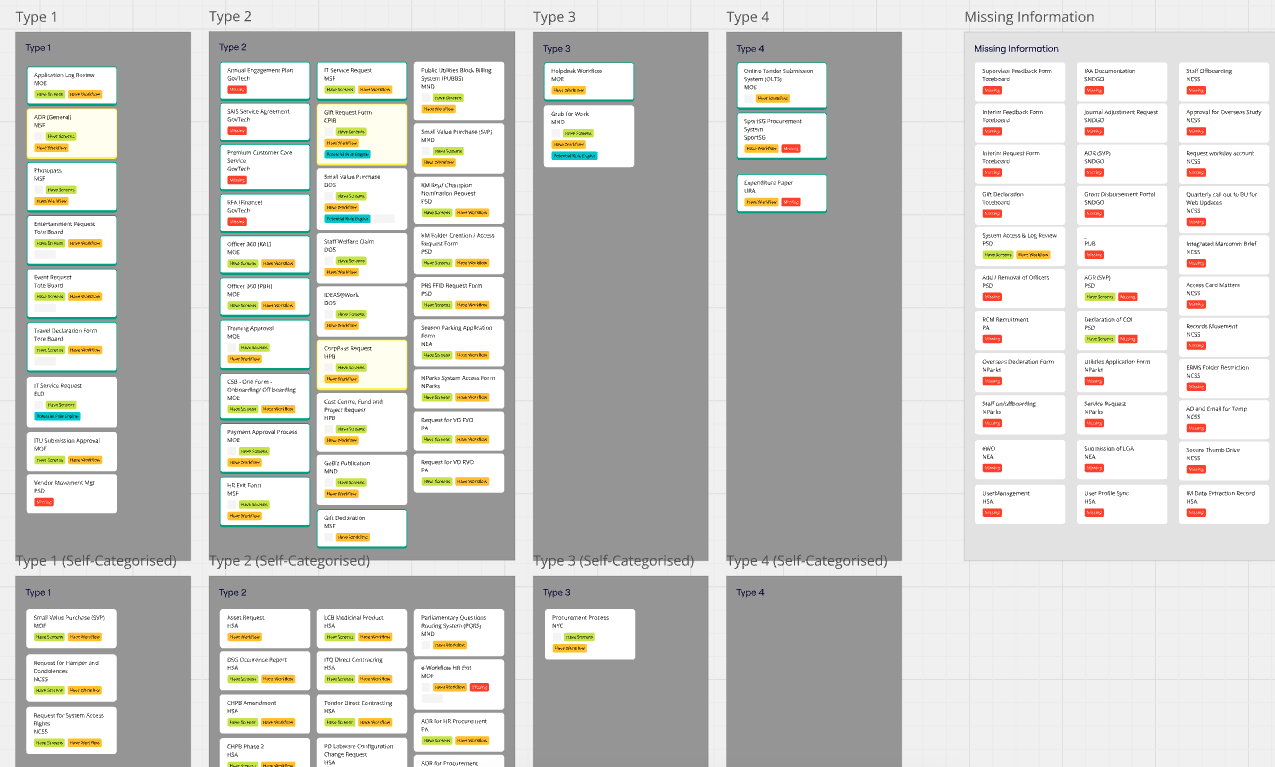
  • Tabletop Research: We analyzed 200+ use cases and mapped them into GovTech’s four workflow types. This helped define key components, prioritize our scope, and guide Opus’s development. We'll also replicate these use cases to demonstrate Opus in action.
Sorting use cases based on their type
  • Prototype Feedback: We built a quick prototype and shared it with MSF’s CIO for early feedback. Key insights included integrating inputs like FormSG and addressing the agency’s use of multiple systems across grant schemes. An orchestrator like Opus can streamline these processes for greater efficiency.
Gathering feedback from our business owner - MSF’s CIO

We learnt that:

  • Agencies operate different workflow engines, leading to inconsistent processes and interoperability issues.
  • IT teams find system fragmentation time-consuming and error-prone.
  • Approval teams struggle with manual handovers, tracking approvals, and disconnected communication.

Outcome and Impact

  • More than 50% faster to construct workflows and reduce tool-switching and manual processing.
  • Unified system overview for IT teams, reducing complexity and improving governance.
  • Reduced compliance risks through automated, policy-driven workflows.
  • Higher efficiency & collaboration across government teams with a single source of truth

Next Steps

  • Pilot Implementation: Test Opus with selected agencies to refine integration and workflows.
  • User Feedback & Iteration: Continuously improve based on real-world use cases. Explore templates and workflow assistants powered by AI.
  • Security & Compliance Audits: Ensure robust data handling and government-grade security.
  • Quality Testing: Conduct performance and resiliency tests to prepare the system for supporting heavy user load
  • Deployment & Adoption Strategy: Develop training and onboarding plans for seamless rollout.

Project team

  • Opus 1 aims to tackle on solving the orchestration problem:
    Sylvia Ng, Justin Cheong, Gabriel Tay and Eugene Wong

  • Opus 2 aims to tackle on solving the human-in-the-loop problem:
    Loren Lim, Li Ying Ling, Yao Peijun and Jaegar Poon

Different problem statements building on a common platform instead of having different systems.