A Singapore Government Agency Website
How to identify
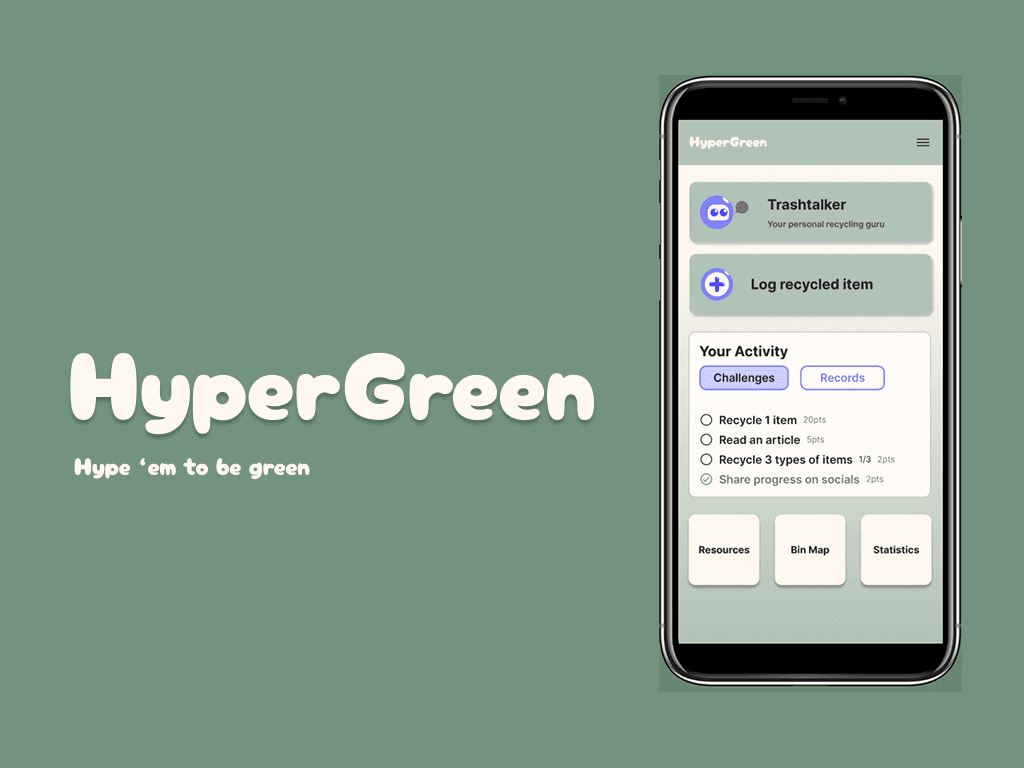
HyperGreen
Reducing wishcycling and encouraging recycling
A web application that helps you make the right call when recycling, and encourages you to build up a habit of recycling. It uses an AI chatbot that can do things from giving recycling recommendations from pictures of items, to telling you the nearest recycling bin for the item. There is also a personal log and mini-challenges to help you build the habit of recycling.
Citizens who are conscious about recycling and want to do more need to be able to conveniently and accurately sort and deposit their recyclables, in order to easily build a habit to recycle and prevent contamination in recycling bins when they have recyclable items to dispose of at home and work, or in public areas. But they are unsure of how best to recycle the recyclables, where to find the information, and may also find it inconvenient to do so. This results in loss of motivation to recycle, and improper recycling that may result in inefficiencies and contamination in the recycling system, thus reducing the nation's recycling rates and putting more strain on our limited landfills.
"40% of the items in recycling bins cannot be recycled due to contamination"
We are often unclear what can or cannot be recycled, and often have to resort to guess work, or search it up on the internet. This results in either "wishcycling" - where people just throw something in the recycling bin hoping that it will be recycled, or people just giving up on recycling. Wishcycling can potentially contaminate recycling bins, which reduces recycling efficiency. Having to always search for information on whether something is recyclable is a hassle that discourages many people too. Therefore, an easy and convenient way to check whether an item is recyclable and how to recycle it could potentially improve the recycling rates of people.
We have interviewed the founder of Recyclopedia, a volunteer-run website dedicated to providing clear and up-to-date information on what can or cannot be recycled, as well as how to recycle those items. This has given us a clearer perspective and more information on the recycling scene in Singapore. We have also interviewed an assistant director from the household branch of the sustainability division in NEA to learn more about the pain points in the current recycling process from NEA’s point of view.
We have also interviewed 7 members of the public about their recycling habits and reasons that motivate or demotivate them to recycle.
Through all these interviews, we found that convenience, along with clear knowledge of what is recyclable or not, is a big factor in whether people will recycle. Also, we found that building a habit for recycling can motivate people to continue recycling in the long term, even if the initial incentive that started the habit is diminished or removed.
We have also found that information about the state and impact of recycling are often not easily accessible or found, though these have been stated by users to be a motivator for recycling and other sustainable practices.
Also, we have found that overall recycling rates are impacted by systemic issues such as bin contamination, and leaks in the recycling system that causes recyclable items to be lost from the system.
There are many cash-for-trash programs managed by the different contractors that NEA appoints for different regions of Singapore. If NEA chooses to appoint a different contractor with a different cash-for-trash program, it would have a negative impact on the citizens who may find their point collection efforts wasted. This would also increase reliance on NEA to stick with the contractor regardless of cost and performance.
Our web app contains an AI chatbot that is capable of recognising multiple items in an image and giving recommendations for recycling these items. It can also find the nearest recycling bin to your current location. You can also ask it anything that you would like to know about recycling! This makes it more convenient and removes uncertainty when recycling.
We have found that building a habit of recycling is the most effective way of improving recycling rates. To achieve this, our web app has an easy and simple way to log your recycling and some mini challenges and rewards for recycling. Users can also get statistics to have a look back at their recycling journey (more below).
Through our user interviews, we have found that knowing the impact of your good deeds is a good motivator to continue recycling. Conversely, not knowing whether you are making a difference can be de-motivator too. Therefore, our web app also provides statistics related to recycling in Singapore, presented in an easy to digest manner for data transparency.