A Singapore Government Agency Website
How to identify


DataSharingAssist (DSA) is an AI-powered tool, enhanced with WOG policies and tools, that empowers public officers to confidently handle inter-agency data requests through data-driven recommendations on data privacy risks and data quality. It streamlines decision-making, making data sharing stress-free and fostering openness and progress.
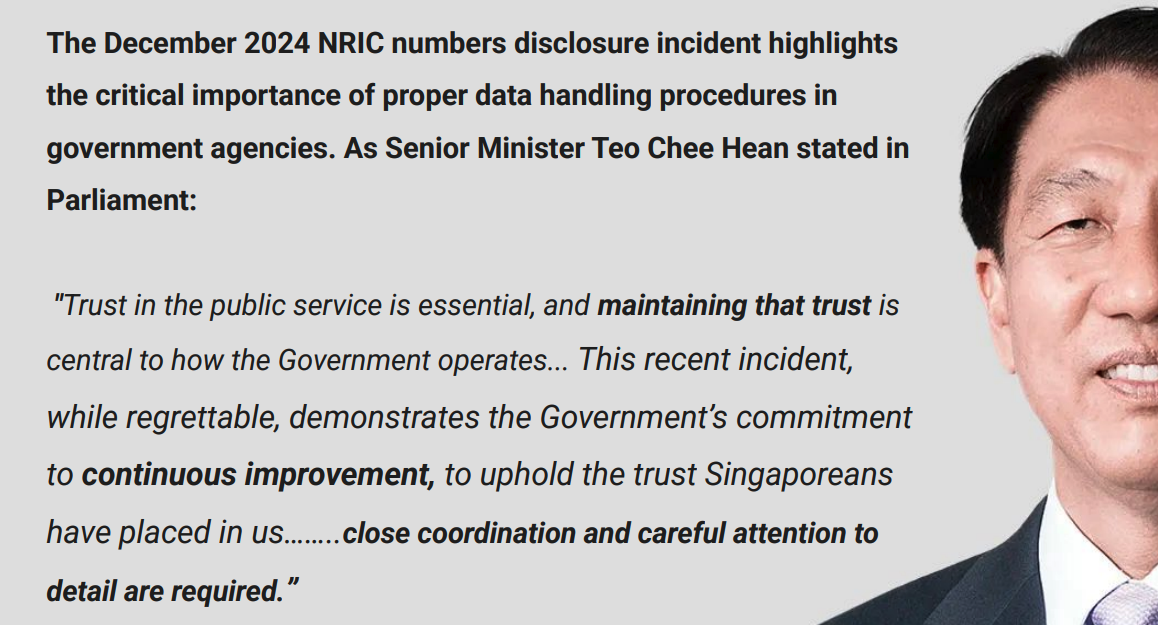
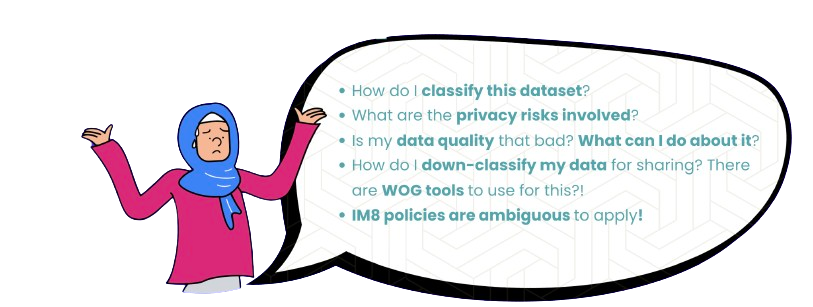
Public officers are required to assess data quality, privacy risks, and data classification when evaluating their agency's datasets, typically requested through the Standardised Data Submission Form (SDSF)—a process that is often challenging and inefficient, as confirmed by our user research.
Complex IM8 guidelines: Difficult to interpret and apply consistently.
Uncertainty in dataset quality and privacy risks: Lack of clear evaluation criteria.
Limited awareness of Whole-of-Government (WOG) tools: Existing solutions for managing privacy risks are underutilized.
No standardized approach: Challenges in down-classifying or cleaning datasets for different use cases.
Delays & inefficiencies: Repeated back-and-forth emails with requesters due to unresolved dataset quality issues.
Frequent reassessments: Changes in use cases require repeated evaluations, even after data sharing has started.
Frustration: Both requesters and providers struggle with inefficiencies.
High resource costs: Data providers spend excessive time working with vendors to diagnose and resolve data quality problems.
DataSharingAssist (DSA) is an AI-powered educational tool, enhanced with WOG policies and tools, designed to help public officers confidently manage inter-agency data requests. By providing data-driven recommendations on data privacy risks and data quality, DSA streamlines decision-making, making data sharing more efficient and stress-free—ultimately fostering openness and progress.
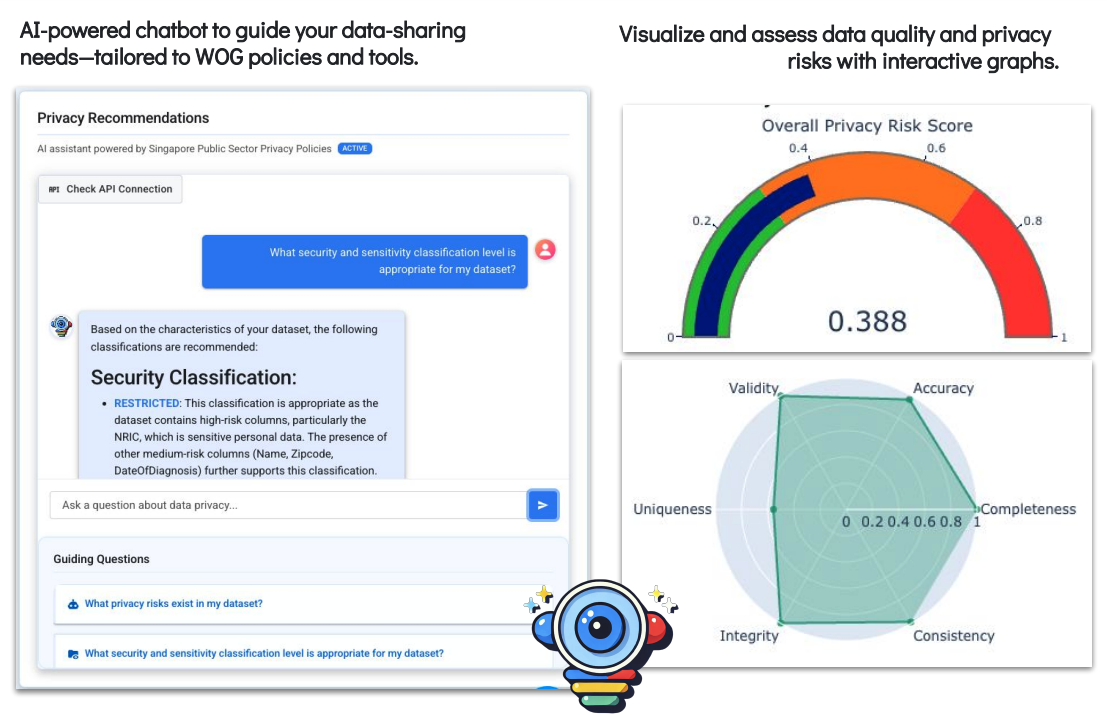
Visual tools to help users assess and identify privacy risks (e.g., overall score, high-risk columns, information uncertainty).
Comprehensive data quality evaluation across multiple dimensions: accuracy, validity, consistency, integrity, completeness, and uniqueness .
A specialized assistant, augmented with WOG policies and tools, that provides guidance on data-sharing queries.
Tailored recommendations based on assessed data quality and privacy risks.
Automated generation of data privacy and quality reports, facilitating smoother decision-making and enabling seamless sharing with data requestors.
Supports audit and compliance documentation, ensuring transparency and accountability.
DSA is built using advanced AI and visualization technologies to provide a seamless user experience:
LLM Implementation with LangChain and OpenAI: DSA leverages a fine-tuned LLM for persona-based interactions, ensuring context-aware and user-specific responses.
Retrieval-Augmented Generation (RAG): Enables DSA to retrieve relevant policy documents and knowledge, providing accurate, real-time guidance.
Interactive Data Visualization: Built with , offering dynamic and intuitive visualizations to help users assess data quality and privacy risks effectively.
Development was streamlined with the coding assistant , while deployment is currently underway using .
DSA delivers measurable improvements to the data-sharing process:
Time Efficiency: Significantly reduces data request processing time, potentially shortening review cycles from months to minutes.
Confident Decision-Making: Supports data-driven decisions with standardized metrics, improving confidence in assessments.
Enhanced Risk Management: Identifies potential privacy risks and suggests mitigation strategies.
Improved Data Quality: Assists data providers in detecting and addressing quality issues more efficiently.
Streamlined Workflows: Simplifies data-sharing approvals with structured, automated workflows.
Policy Compliance: Helps align with government data privacy protection policies through automated checks and recommendations.

Primarily based on insights from user research and the Feedback Bazaar, our roadmap focuses on further enhancing DSA's capabilities through the following improvements:
Enhanced chatbot with advanced reasoning capabilities
Centralized discovery of public dataset repositories
In-chatbot support for privacy measures application
Expanded recommendation engine as a validator
Community-driven knowledge base
Collaboration between data requestors and data providers
User experience optimization
Our initial goal is to position DataSharingAssist as an educational tool for Whole-of-Government (WOG) adoption. It simplifies the complexities of data sharing, making it a seamless and efficient process that fosters openness and collaboration across government agencies. By leveraging AI-driven insights and automation, it enables public officers to make informed, secure, and policy-compliant data-sharing decisions.
The {build} 2025 program has provided an opportunity to address a critical public sector challenge, and we look forward to seeing how DataSharingAssist continues to evolve. As we expand its capabilities, our goal is to enhance data governance, streamline workflows, and strengthen trust in inter-agency data exchanges.
 Anshu Singh Research Engineer (GovTech, GTO) |
 Lara Chia Digital Business Analyst (MOM, GDT) |
 Brandon Lee Digital Business Analyst (Customs, GDT) |
 Jimmy Neo Senior Digital Services Manager (MOM, GDT) |
Special thanks to Ghim Eng Yap, Director of Data Engineering Practice (including data privacy), for his invaluable support and input. He also serves as the business owner of this project.
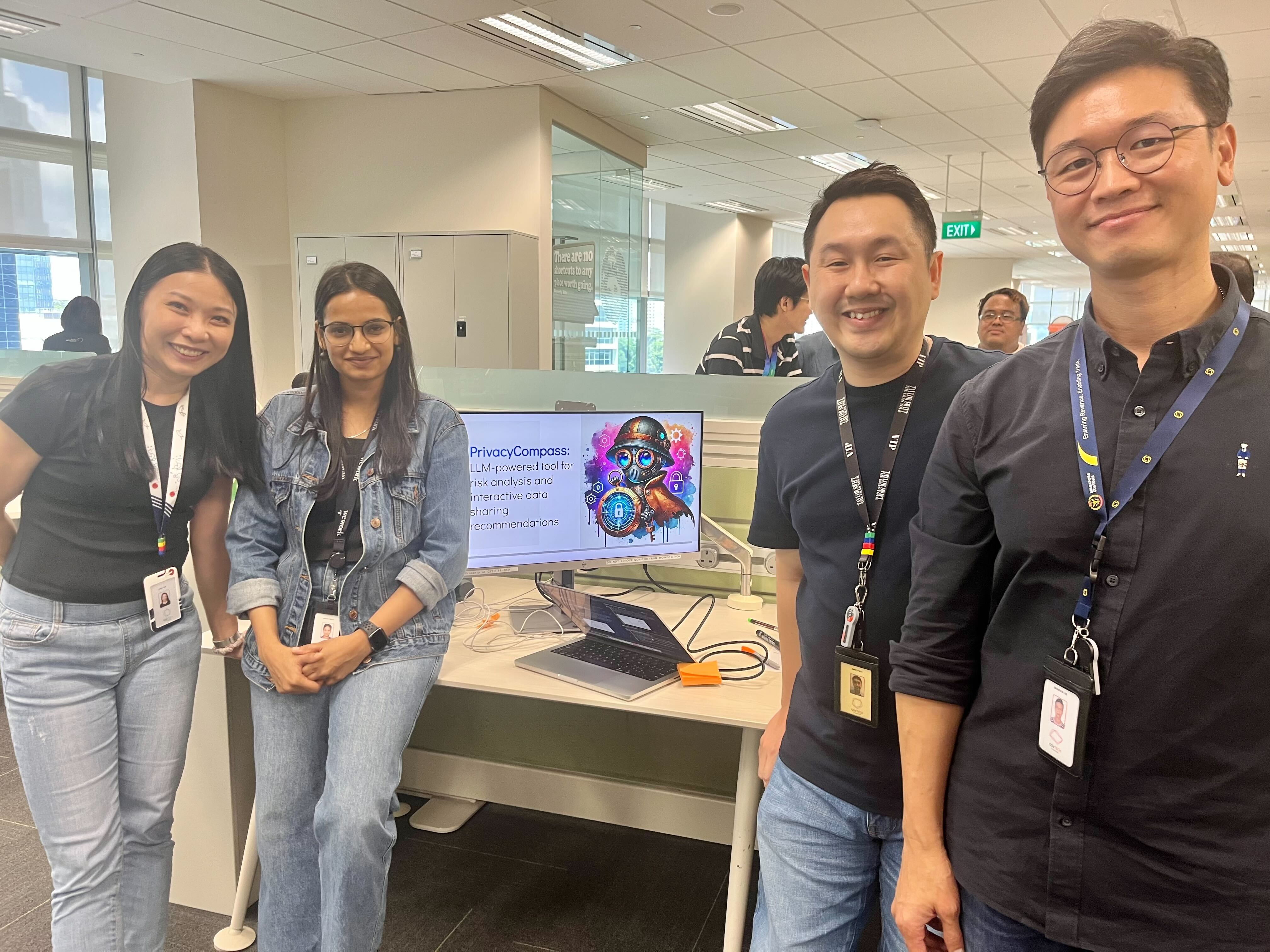
Moment to remember: Team formation day a.k.a kick-off day ❤️
This project was developed as part of {build} 2025, a government innovation program. For more information, visit .