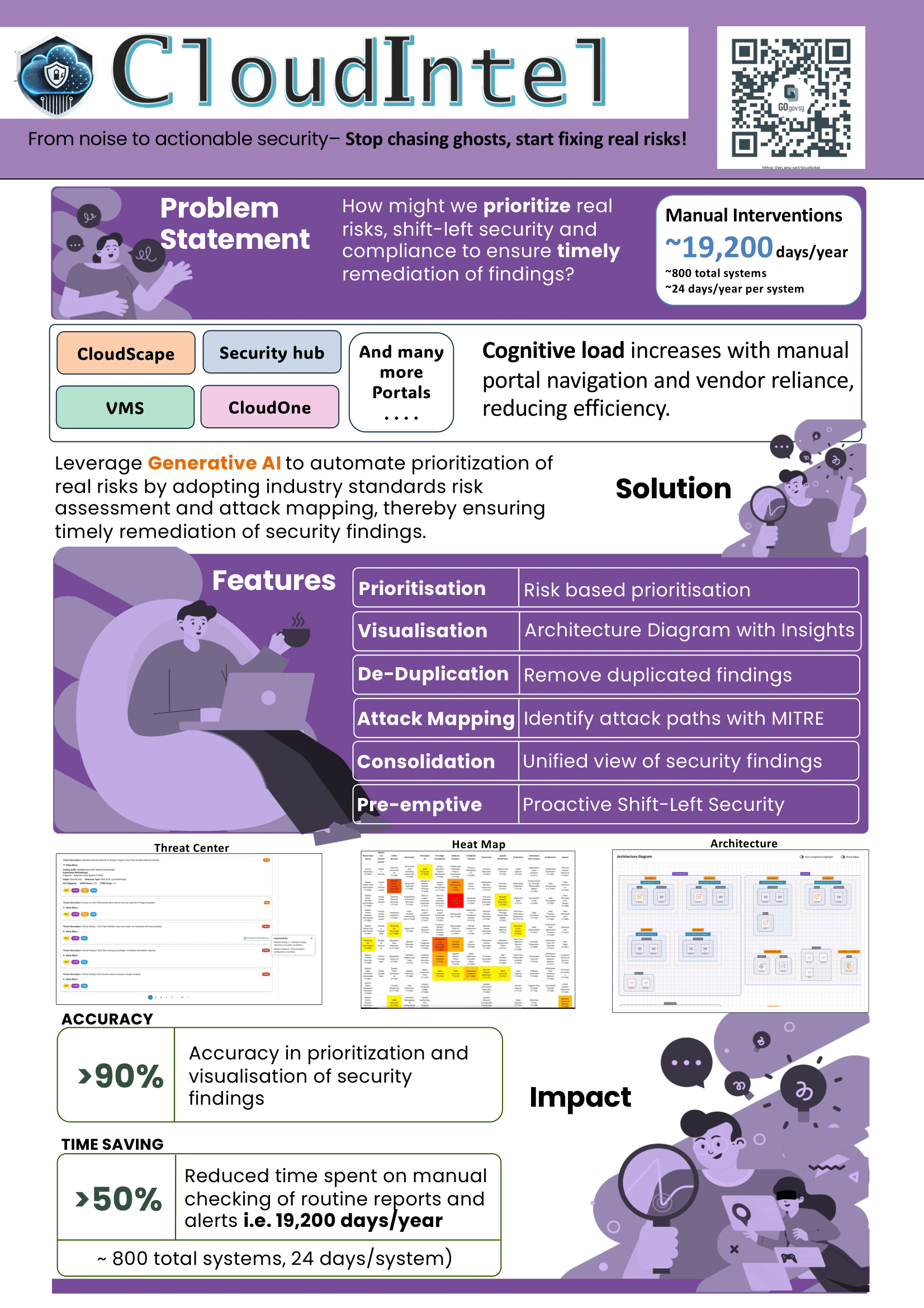
How might we prioritize real risks, shift-left security and compliance to ensure timely remediation of findings?
Cognitive load increases with manual portal navigation and vendor reliance, reducing efficiency.
Problem Formulation Process
Our initial focus on a cloud security dashboard evolved after discussions with CISOs, revealing that the real challenge extends beyond visibility. Security teams struggle with fragmented data, duplicate findings, poor risk prioritization, and late-stage security reviews.
Fragmented Security Data – Security findings are dispersed across multiple tools, creating data silos and preventing a comprehensive risk overview.
Duplicate Vulnerabilities – The same security issue is often flagged by multiple tools, inflating issue counts and contributing to alert fatigue.
Lack of Prioritization – Without a standardized severity and impact assessment, security teams struggle to focus on the most critical risks.
Late-Stage Security Reviews – Security checks are often conducted late in the development lifecycle, resulting in costly and time-consuming remediations.
To address these challenges, we refined our problem statement to be solution-agnostic, focusing on unified security insights, noise reduction, and proactive shift-left security practices rather than just a dashboard.
Solution
We propose a unified cloud security platform that streamlines risk management, enhances compliance, and integrates security into development workflows by aggregating, deduplicating, and prioritizing security findings across multiple AWS accounts.
Key Features
Prioritization – Risk-Based Prioritization by ranks vulnerabilities based on industry-standard frameworks (KEV, EPSS, CVSS) to highlight critical threats.
Visualisation – Provides interactive architecture diagrams with highlighted vulnerable resources for in-depth risk analysis.
De-Duplication – Uses Generative AI to remove duplicate vulnerability findings, reducing alert fatigue.
Attack Mapping – Identifies attack paths using GenAI and industry standard MITRE ATT&CK framework for enhanced threat context.
Consolidation - Unified view of security findings using Heat Map
Pre-emptive – Proactive shift-left compliance through security assessments early in development phase, allowing timely remediation.
Impact and Outcomes Analysis
Measuring Success
To evaluate our solution’s effectiveness, we will track the following key metrics:
Reduction in Vulnerability Noise – Percentage decrease in duplicate and redundant security findings.
Improvement in Remediation Efficiency – Reduction in the average time to resolve critical vulnerabilities.
Increase in Early Security Reviews – Percentage of security checks conducted pre-deployment in CI/CD pipelines.
Reduction in High-Risk Vulnerabilities – Decline in the number of critical security issues across AWS accounts.
User Adoption & Satisfaction – Feedback on usability, effectiveness, and overall impact from security and project teams.
By providing a consolidated, prioritized, and proactive approach to cloud security, our solution will reduce operational overhead for security teams while enabling project teams to build secure and compliant cloud environments from the outset.
Future Steps
Enhance Risk Scoring & Prioritization – Refine risk assessment using KEV, EPSS, and CVSS for more accurate threat ranking.
Advance Automation – Optimize deduplication and remediation workflows to reduce manual effort and improve response time.
Develop Playbooks & Best Practices – Provide guidance and frameworks to facilitate shift-left security adoption.
Drive Training & Adoption – Support agency-wide education and adoption initiatives to maximize solution effectiveness.