A Singapore Government Agency Website
How to identify

Government officers worldwide need a reliable way to verify foreign documents when full legalisation is too costly but some assurance is still required. The gap between legalisation and blind acceptance makes fraud detection difficult. A mid-level verification solution can help officers spot obvious fraud while reducing unnecessary burdens on citizens
Government agencies worldwide struggle with efficiently verifying the authenticity of foreign-issued documents. The lack of a reliable verification process leads to processing delays and increased fraud risks, ultimately hindering effective public service delivery. While full legalisation provides the highest level of assurance, it is often costly, time-consuming, and impractical. Manual validation, on the other hand, is prone to errors and varies across officers, creating inconsistencies. This leaves a gap between exhaustive verification and blind acceptance, highlighting the need for a more efficient, mid-level verification solution.
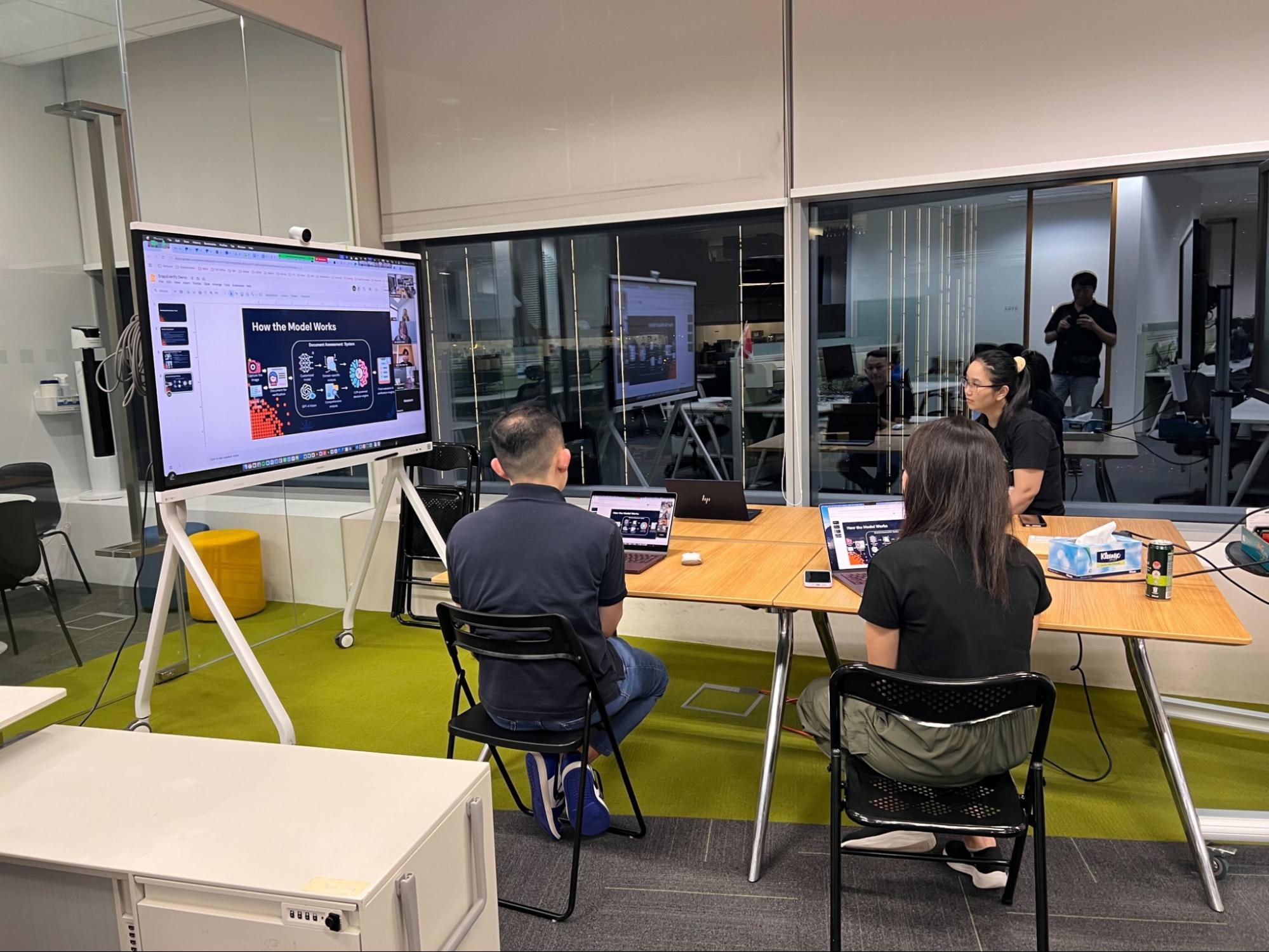 Our team conducted extensive research and engaged with members of the International Council for Information Technology in Government Administration (ICA) to understand the pain points experienced by various countries. We identified key problem areas:
Based on these insights, a solution is needed that ensures both efficiency and security. We set out to develop an AI-driven mid-level verification tool designed to assist officers in quickly identifying obvious fraud. This tool aims to reduce unnecessary burdens on both government agencies and citizens, enhancing document verification, strengthening fraud detection, and enabling seamless adoption.
Borderless Trust is an AI-powered document verification platform that leverages both customised models and LLMs to assess document authenticity. Our solution provides domain-specific analysis tailored to meet particular needs while providing comprehensive insights that deliver a broader perspective on each document.
Through AI-assisted analysis, the solution significantly accelerates document checks while maintaining high levels of accuracy. This reduction in manual effort frees up valuable time for government agencies, allowing them to focus on more complex tasks and improving overall operational efficiency.
By leveraging advanced AI-driven approaches, the system is capable of detecting subtle inconsistencies and anomalies that may elude human inspectors. This results in a marked reduction in the acceptance of fraudulent documents, enhancing the integrity of government processes.
Designed for ease of deployment, the solution can be rapidly scaled across multiple countries. This scalability opens up the potential for adoption by government agencies worldwide, helping them streamline document verification in a cost-effective manner.
We have presented our solution to a selected group of countries, including Botswana, Canada, Israel, and Portugal. Botswana and Canada have further signed up to pilot test our prototype, to demonstrate and evaluate the solution in real-world scenarios. Early feedback indicates promising outcomes. These results validate the solution’s potential and set the stage for broader testing and implementation across other countries.
To enhance Borderless Trust further, we plan to: